 Pulseri

Customer retention is keeping the customers you already have, so they continue to buy or subscribe over time. You measure it as the share of customers at the start of a period who are still customers at the end.
Below you will find the definition, the formula with a made-up subscription example, strategies that fit a small team and a plan for your first week.
What customer retention means
Stripe defines customer retention as keeping customers over time by continuing to deliver value after their first purchase. 1 The meaning is the same for a software subscription, an agency retainer or a shop: someone paid you once, and retention is whether they do it again.
Three nearby words are easy to mix up:
- Churn is the share of customers who leave in a period. It is the opposite of retention, so a 90% retention rate means 10% churn. The customer churn guide shows how to calculate it and how to spot it early.
- Satisfaction is how a customer felt about a moment, such as a support chat. A satisfied customer can still leave, for example when the budget is cut.
- Loyalty is an attitude: would they recommend you, would they choose you again. Retention is the behavior you can count. The two usually move together, but they are different numbers. The customer loyalty guide shows how to measure the attitude side.
How to calculate customer retention rate
Pick a period, such as a month, and count three things:
- S: customers at the start of the period.
- E: customers at the end of the period.
- N: customers who joined during the period.
Retention rate = (E - N) / S x 100
Subtracting N removes new customers, because they were not there at the start and cannot be "retained". Stripe's definition of the rate also leaves out customers added during the period. 1 If you skip this step, a good sales month hides a leaking base.
Worked example: logo and revenue retention
Made-up example: a small subscription business starts the month with 100 customers who pay a total of $5,000 a month. During the month:
- 12 customers cancel. Together they paid $400 a month.
- 5 customers upgrade, adding $300 a month.
- 3 customers downgrade, removing $100 a month.
- 30 new customers join and pay $1,800 a month.
The business ends the month with 118 customers (100 - 12 + 30).
| Measure | Calculation | Result |
|---|---|---|
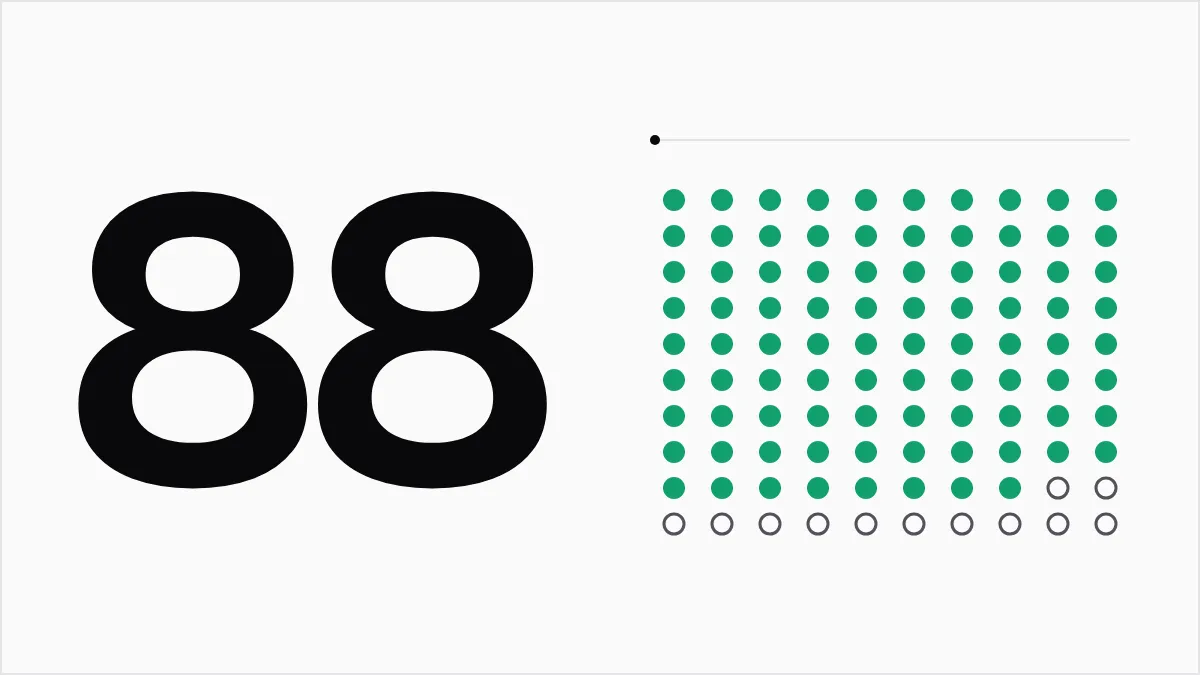
| Logo retention | (118 - 30) / 100 | 88% |
| Net revenue retention | (5,000 - 400 + 300 - 100) / 5,000 | 96% |
| Gross revenue retention | (5,000 - 400 - 100) / 5,000 | 90% |
| Wrong: ignoring new customers | 118 / 100 | 118% |
Logo retention counts customers. Revenue retention counts money from the same starting group, so the new customers' $1,800 stays out of it. Stripe lists revenue retention as a separate measure that accounts for upgrades, downgrades and cancellations. 1 Gross revenue retention is the same sum without the upgrades, which shows how much revenue you kept before any growth from existing customers.
The two rates differ here because the customers who left were small ones and some who stayed grew. A business that loses its biggest accounts can show a high logo rate and a poor revenue rate. Track both.
What a rate like 80% means
An 80% rate means 20 of every 100 starting customers left in that period. The period matters a great deal. If a monthly rate stayed at 88% for twelve months, only about 22 of 100 customers would remain after a year (0.88 to the power of 12). A monthly figure and an annual figure are not comparable, so write the period next to every number.
Pulseri does not calculate retention rate. You count customers in your billing system or a spreadsheet, and the formula above is enough.
Why retention matters for a small team
Every customer who stays is revenue you did not have to win again. An article in Harvard Business Review says that, depending on which study you believe and what industry you are in, acquiring a new customer is anywhere from five to 25 times more expensive than retaining an existing one. 2 The same article points to research by Bain & Company's Frederick Reichheld showing that increasing customer retention rates by 5% increases profits by 25% to 95%. 2
Treat those as a wide range from the author's cited research, not a prediction for your business. A small team still has a practical reason to care: it has fewer hours to spend on finding new customers, so each cancellation is harder to replace.
Customer retention strategies that fit a small team
Most strategy lists are written for online stores or large marketing teams. A small subscription or service team gets more from fixing the points where customers leave. Start from the signal you see, work out the likely cause and choose one action.
| Signal | Likely cause | One action | Effort |
|---|---|---|---|
| Customers cancel in the first month | They never reached a first result | Write a short first-week guide and check in once | Low |
| Support threads stay open for days | Slow or unclear answers | Set a reply time and review the oldest threads weekly | Medium |
| Customers leave and say nothing | You find out too late | Ask one short question after a key moment | Low |
| Payments fail, then the account lapses | Expired cards, not a decision to leave | Send a reminder before renewal and retry failed payments | Low |
| Long-time customers drift to a competitor | No reason to stay beyond habit | Ask what they would change, then share what you fixed | Medium |
| Customers leave but may return | The product did not fit then | Send a note when something they asked for ships | Low |
Stripe's own list covers the same ground: set accurate expectations, make setup easy, offer responsive support, contact customers likely to leave and reduce failed-payment churn with retries and notifications. 1
Loyalty points and referral codes work for repeat-purchase shops. For a subscription they are a later step, once the basics above are in place.
Listen early
The cheapest early warning is asking. Send one short question after the moment a customer first gets value, and another after a support conversation or a payment. Keep a limit on how often the same person is asked. Pulseri's relationship cooldown waits 90 days by default between relationship surveys to one person, and you can change it. For how to word and time the questions, see how to ask for feedback without annoying people.
A low score is a signal worth reading the same day. Pulseri's alerts and automations send low scores to Slack or Microsoft Teams, and event surveys can start from a Stripe or Zendesk event. Tell a customer you read their answer, even if the fix takes longer. The voice of the customer guide sets up a weekly review of the comments.
A first-week plan
- Pick the period. Choose a month or a quarter and write it on your retention sheet.
- Count. Record S, E and N for the last three periods from your billing records.
- Calculate both rates. Work out logo retention and net revenue retention, as in the table above.
- Read the exits. Open the last ten cancellations and write the reason beside each. Where you have no reason, mark it as unknown.
- Choose one row from the strategy table. Pick the signal that matches most of your exits.
- Add one question. Ask it right after the customer's first result, using the same wording each time so answers are comparable. A score such as the NPS score gives you a number to track beside retention.
- Review in a month. Compare the new period with the old ones before you change anything else.
Where Pulseri fits
Pulseri asks the right person at the right moment and keeps the answers and comments in one place, which helps with step 6 and with any question you ask customers who are leaving. You can see how customer feedback surveys work, or read about feedback for SaaS founders. More guides are on the Pulseri blog.
Sources
- Customer retention: why it matters and how to improve it (Stripe) (retrieved 5 Nov 2026) Back to text: 1, 2, 3, 4
- The Value of Keeping the Right Customers (Harvard Business Review) (retrieved 5 Nov 2026) Back to text: 1, 2